

Texas leads the nation in billion-dollar weather disasters, and every storm season brings a new wave of policyholders who paid their premiums on time only to watch their insurer stall, lowball, or flatly deny a legitimate claim.
Proving bad-faith insurance tactics in court is about showing that the company chose profit over its policyholder’s rights. However, that’s often easier said than done.
This guide breaks down what goes into proving a bad-faith insurance claim under Texas law, the evidence that carries the most weight, and how a case goes from a denied claim to a courtroom verdict.
Bad-Faith Insurance Claims in Texas: Key Facts
What Counts as Bad Faith Under Texas Law?
Texas recognizes two separate origins of a bad-faith claim, each of which requires proof of different elements. Knowing which option (or options) fits your situation can determine the broader strategy for your case.
Common Law Bad Faith
Common law bad faith arises from the duty of good faith and fair dealing that Texas courts have long imposed on the insurer-policyholder relationship.
For your claim to succeed under this theory, you must show that your insurer had no reasonable basis for denying or delaying your claim and knew or should have known that such a basis didn't exist. Courts look at whether the insurer investigated fairly or simply built a paper trail to justify a denial it had already decided on.
Statutory Bad Faith
Chapter 541 of the Texas Insurance Code prohibits unfair claim-settlement practices, including misrepresenting policy terms, failing to investigate promptly, and refusing to pay claims without conducting a reasonable investigation. Chapter 542, meanwhile, sets hard deadlines for acknowledging, investigating, and paying claims.
If an insurer misses those deadlines, it can trigger statutory penalties even without proof of malice, which makes this the more straightforward path in many bad-faith lawsuits in Texas.
Where Bad Faith Shows Up Most Often in Texas Claims
Bad-faith conduct isn't limited to one type of policy. It tends to surface anywhere an insurer has an incentive to minimize a payout, and Texas policyholders frequently encounter it across several common claim categories, including:
- Homeowners and residential property claims involving fire, wind, hail, water, or foundation damage.
- Hurricane and named-storm claims, where deductible calculations and multi-peril policy language often get misapplied.
- Commercial property and business-interruption claims, where insurers dispute may lost-income calculations.
- Flood and water damage claims, where coverage disputes hinge on the source of the water.
- Roof damage claims, where insurers frequently attribute storm damage to normal wear and tear.
Recognizing which category your claim falls into will help you better understand key policy provisions, legal deadlines, and the types of evidence that matter most.
Gathering the Evidence Insurers Can't Ignore
.webp)
The viability of a bad-faith case depends on documentation. Insurers keep detailed internal records, and those records are often the plaintiff's strongest weapon once a lawsuit forces them into the open.
Claim File and Adjuster Notes
The insurer's own claim file, which can be obtained through discovery, may contain notes, engineer reports, and communications that contradict the reasons given in a denial letter. Discrepancies between what adjusters said internally and what the company told the policyholder are some of the most persuasive evidence in bad-faith litigation.
Communication Records and Timelines
A documented timeline of every call, letter, and email can reveal patterns that a single denial letter doesn’t. Look for these red flags when building your file:
- Requests for the same documentation multiple times;
- Unexplained silence stretching past the deadlines articulated in Chapter 542;
- Changing justifications for the denial over the life of the claim;
- Adjuster statements that contradict the written policy language.
Independent Expert Reports
Insurance companies often rely on in-house or hired engineers who minimize damage estimates. An independent expert, whether it’s a structural engineer, contractor, or medical professional, can provide a competing, defensible valuation for a jury to weigh against the insurer's numbers.
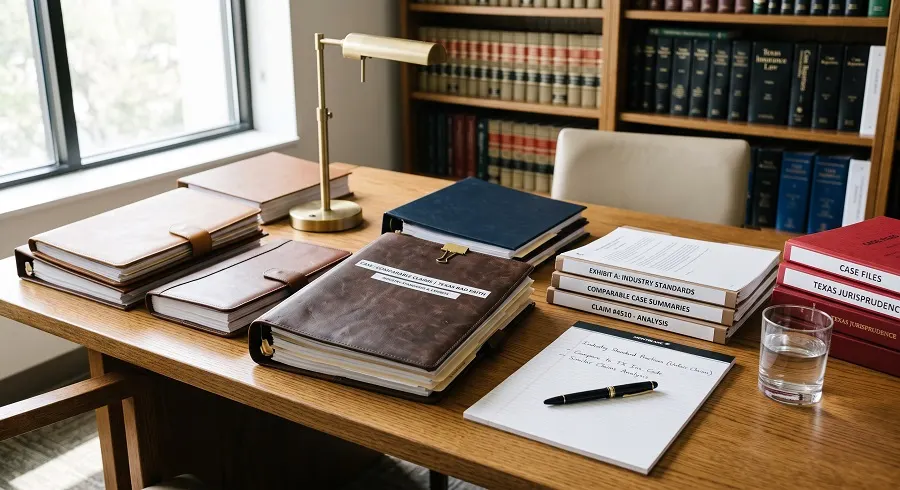
Comparable Claims and Industry Standards
Pointing to how an insurer has handled similar claims, or how its conduct measured against standard claims-handling practices, can help establish that a denial wasn't an isolated judgment call but part of a broader pattern of bad-faith behavior.
Satisfying the Elements of a Bad-Faith Claim
Texas courts require specific steps to be taken before a bad-faith claim can reach a jury, and each element needs its own supporting evidence. Here’s what you must do to make sure your claim progresses.
Establish That Liability Was Reasonably Clear
You must show that the insurer's obligation to pay was reasonably clear given the facts and the policy language available at the time. Ambiguous policy terms are generally interpreted in the policyholder's favor under Texas law, which can bolster your case if the denial hinged on a debatable exclusion.
Show That There Was No Reasonable Basis for Denial
This is the heart of most bad-faith cases. The evidence needs to demonstrate that the insurer lacked any reasonable basis for denying, delaying, or underpaying the claim, not just that you disagree with the outcome.
Demonstrate Knowing or Reckless Conduct
For the more serious violations outlined in Chapter 541, plaintiffs must show that the insurer acted knowingly or with conscious indifference. Internal communications, training materials, and prior complaint histories may supply this proof.
What Happens After You File a Bad-Faith Lawsuit?
Once a bad-faith claim proceeds to litigation, the case follows a fairly predictable sequence of steps, though the pace and pressure points differ from a standard personal injury lawsuit.
Discovery and Depositions
Discovery is where the main body of evidence comes to light. Depositions of the adjuster, claims supervisor, and any retained experts may expose inconsistencies that weren’t evident in the written correspondence.
Settlement Negotiations
Most bad-faith cases in Texas resolve before trial once the insurer sees the strength of the evidence assembled during discovery. When a policyholder's attorney has documented a clear pattern of unreasonable conduct, insurers tend to reassess their exposure quickly.
Trial
When a case does go to trial, the plaintiff’s presentation typically centers on the timeline of the claim, the discrepancies between internal documents and denial letters, and expert testimony on the true value of the loss. A clear, well-organized narrative generally resonates more with a jury than a purely technical argument.
The Role of Witness Testimony
Adjusters, claims supervisors, contractors, and independent experts often testify to fill in the gaps that the official documentation leaves behind. Credible, consistent testimony from someone who inspected the damage firsthand or can speak to how the insurer typically handles similar claims will likely carry as much weight with the court as the record itself.
After the Verdict: Collecting and Enforcing Your Judgment
Winning a bad-faith case doesn't automatically put money in a policyholder's hands. Insurers can appeal a verdict, and a judgment may have to be enforced if the carrier doesn't pay voluntarily.
An attorney with experience in bad-faith litigation will typically stay involved throughout this stage to make sure their client collects the judgment, including any statutory interest and fees awarded, and to respond to an appeal if the insurer files one.
Damages Available in a Texas Bad-Faith Case
A successful claim can be worth more than what the original policy promised. Depending on which statute applies, the damages may include:
- The full amount of the underlying claim
- 18% annual interest on unpaid benefits
- Attorney's fees and court costs
- Treble (triple) damages for knowing violations
- Damages for mental anguish in certain cases involving egregious conduct
Talk to a Texas Bad-Faith Insurance Attorney Today
At Omar Ochoa Law Firm, we build the kind of evidentiary records that insurance companies hope policyholders never assemble. Our bilingual team is available 24/7, and we take bad-faith insurance cases on contingency, which means you’ll owe us nothing unless we win for you.
We proudly serve clients throughout the great state of Texas, with offices in McAllen, Edinburg, San Antonio, and Houston. Contact us today for a free, confidential case review.

Omar Ochoa has been nationally recognized as one of the best young trial lawyers in the country. He's represented clients in federal and state courts and arbitrations throughout the United States and internationally. He is highly experienced in a wide range of complex litigation and has handled a variety of cases. He has recovered hundreds of millions of dollars for clients of all types — from individuals to mid-sized business owners to multi-national companies.
Table of Contents
Insurer Playing Games with Your Claim?
The skilled legal team at Omar Ochoa Law Firm is available 24/7 and takes bad-faith cases on contingency, so you’ll pay nothing unless we win.
Contact UsThis is some text inside of a div block.
Contact UsThe Insurance Company Has a Legal Team Protecting Its Interests. You Should Too.
The adjuster who denied or lowballed your claim didn't make that call alone, and you shouldn't have to challenge the decision alone either.