


A hailstorm cracks your roof, and the repair estimate from your own contractor comes in thousands of dollars above what the insurance adjuster is offering. You've paid your premium every year, on time, expecting your homeowners insurance to cover exactly this kind of damage. Instead, you're stuck negotiating with the same company you trusted to protect your home.
Texas homeowners' insurance laws are a shield against insurance company delays, denials, and bad-faith practices. These consumer protections have real teeth, and understanding your rights under Texas law can mean the difference between a fair settlement and a prolonged fight. If your insurance company isn't playing by the rules, our Texas insurance lawyers can help you enforce your rights and secure the compensation you're owed.
Is Homeowners Insurance Required Under Texas Law
No state law in Texas requires you to carry homeowners insurance. However, if you have a mortgage, your lender will almost always make coverage a condition of the loan, since the bank has a financial stake in protecting the property that secures your debt. Homeowners who own their property outright aren't legally obligated to buy a policy either, but going without one means a single fire, hailstorm, or plumbing failure could wipe out years of home equity with no way to recover the loss.
Texas homeowners insurance laws don't mandate that you buy a policy, but they heavily regulate the companies that sell one, from how quickly they must respond to your claim to when they're allowed to cancel your coverage. Understanding these Texas homeowners insurance laws is what turns a stack of policy paperwork into real, enforceable protection for your home.
What Your Texas Homeowners Insurance Typically Covers
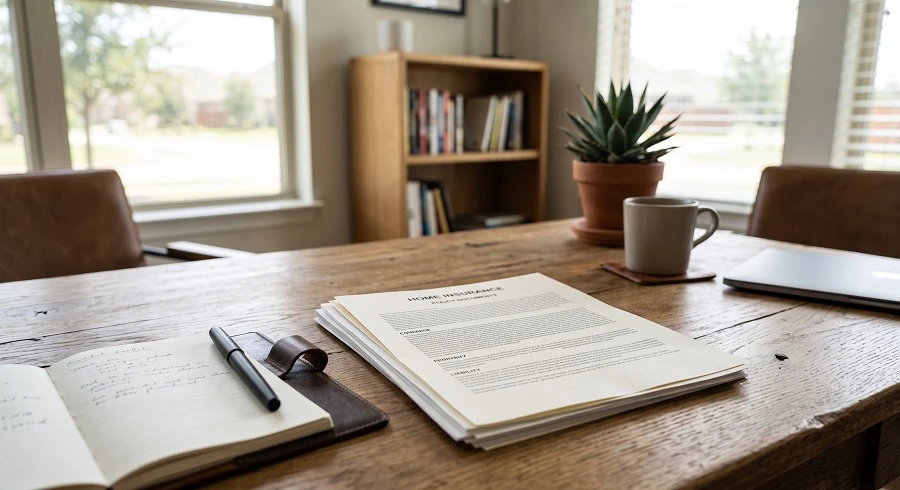
Before diving into the legal protections, it's essential to understand what most Texas homeowners insurance policies provide. Standard homeowners insurance coverage includes five key components that work together to protect your property and finances.
- Dwelling coverage: Protects the structure of your home itself, including attached structures like garages. This coverage helps pay for repairs or rebuilding if covered perils like fire, windstorms, or hail damage your home.
- Personal property coverage: Protects your belongings inside the home, with everything from furniture and clothing to electronics and appliances. Most policies cover personal property for a percentage of your dwelling coverage amount.
- Other structures coverage: Extends protection to detached structures on your property, such as separate garages, sheds, fences, and other buildings not connected to your main house.
- Liability coverage: Protects you if someone is injured on your property or if you accidentally damage others' property. This coverage can help pay for legal costs and damages if you're sued.
- Additional living expenses (ALE): Coverage pays for temporary housing and increased living costs if you're displaced from your home due to a covered loss. This can include hotel bills, restaurant meals, and other expenses above your normal cost of living.
It's worth noting that flood insurance claims require a separate policy, as standard homeowners insurance doesn't cover flood damage. Similarly, if you live in some coastal regions, you may need windstorm coverage through the Texas Windstorm Insurance Association.
Replacement Cost vs. Actual Cash Value, Deductibles, and Coverage Limits
Two homeowners with identical damage can receive very different payouts depending on how their policy defines value. Replacement cost value (RCV) policies pay what it actually costs to rebuild or replace damaged property at today's prices. Actual cash value (ACV) policies subtract depreciation for the age and condition of what was lost, which can leave an older roof, floor, or appliance covered for a fraction of its replacement price.
Texas homeowners insurance laws don't dictate which valuation method your insurer must offer, so this is a decision you make when you buy the policy, not after a loss occurs.
Your declarations page also spells out your deductible, the amount you pay out of pocket before coverage kicks in, along with separate dollar limits for categories like personal property or other structures. Many Texas homeowners insurance policies carry a percentage-based windstorm or hail deductible rather than a flat dollar amount, and insurers must disclose this separately so you aren't caught off guard after a storm.
Texas Insurance Laws That Protect Homeowners
Texas has enacted comprehensive laws specifically designed to protect homeowners from unfair insurance practices. The Texas Department of Insurance enforces these laws and imposes significant penalties on insurance companies that violate them.
Prompt Payment Requirements: Your Right to Quick Action
One of the most powerful protections in Texas law is the prompt payment statute found in Texas Insurance Code Chapter 542. This law requires insurance companies to act quickly on your claim, with specific deadlines that must be met.
When you file an insurance claim, your insurance company has exactly 15 days to acknowledge receipt of your claim. During this time, they must also begin investigating your claim and request any additional documentation they reasonably believe they'll need.
Once your insurance carrier receives all requested information, it has 15 business days to accept or reject your claim. If they accept your claim, payment must follow within five business days.
Violating these deadlines has severe consequences. Insurance companies that delay payment beyond the statutory timeframes must pay 18% annual interest on the claim amount, plus the policyholder's attorneys' fees.
Texas Windstorm Insurance Association: Coastal Protection
.webp)
For homeowners along the Texas coast and parts of Harris County, the Texas Windstorm Insurance Association (TWIA) serves as the insurer of last resort for wind and hail damage. TWIA was created because many private insurance companies won't provide windstorm coverage in these high-risk coastal areas.
TWIA provides essential coverage when your mortgage lender requires windstorm insurance, but private insurers won't offer it. The association covers properties in 14 coastal counties and specific parts of Harris County east of Highway 146. However, you can't simply choose TWIA. You must first be denied coverage by a private insurance company to then qualify for TWIA.
TWIA won't sell you a policy if a hurricane currently in the Gulf of Mexico, so coastal homeowners must plan ahead and secure coverage during calm weather periods.
The Texas FAIR Plan: Coverage When No Insurer Will Cover Your Home
TWIA solves the wind and hail problem for coastal counties, but it doesn't help if a private insurer simply won't sell you a standard homeowners policy at all, regardless of where you live. Texas created a separate insurer of last resort for that situation: the Texas FAIR Plan Association. If at least two licensed insurers have turned you down for coverage in the voluntary market, the Texas FAIR Plan can issue basic, named-perils property insurance so your home isn't left completely uninsured.
FAIR Plan coverage is intentionally more limited than a standard homeowners policy, and it's meant to bridge back into the private market rather than be a permanent solution. Homeowners in TWIA's 14 coastal counties still need a separate windstorm policy, since the FAIR Plan doesn't cover wind or hail in that territory. If you've been declined coverage, ask your agent about FAIR Plan eligibility or contact the plan directly.
Consumer Bill of Rights: Know Your Protections
The Texas Department of Insurance requires insurance companies to provide every policyholder with a Consumer Bill of Rights. This document outlines fundamental protections that most homeowners may not realize they have.
You have the right to receive a written explanation if your claim is denied or your policy is canceled. The insurance company cannot simply reject your claim without providing detailed reasons for their decision. You also have the right to contact the Texas Department of Insurance for help with complaints or questions about your coverage.
Perhaps most importantly, you have the right to hire an attorney or public adjuster to help with your claim. Insurance companies cannot penalize you for seeking professional help when navigating complex claims processes.

Restrictions on Claims History Discrimination
Texas law protects homeowners from being penalized for claims beyond their control. Insurance companies generally cannot increase your premiums or cancel your policy based solely on claims caused by natural disasters that didn't result in a payout. Most insurers pull this history from a CLUE (Comprehensive Loss Underwriting Exchange) report, which tracks claims tied to your home for the past seven years regardless of who owned it at the time.
Your credit history can influence insurance rates in Texas, but insurance companies cannot deny coverage based solely on poor credit. They must consider multiple factors when determining your risk profile and premium costs.
Ask About Discounts: Lowering Your Texas Homeowners Insurance Premium
Texas homeowners insurance laws work in your favor when it comes to lowering your premium, not just when something goes wrong. Insurers commonly offer discounts for a monitored burglar or fire alarm, a recently updated roof, storm shutters or impact-resistant windows, and bundling your homeowners and auto policies with the same carrier. If you haven't filed a claim in the past few years, ask whether you qualify for a claims-free discount as well.
Texas law also entitles homeowners who install qualifying dead-bolt locks or a certified electronic burglar alarm system to a premium reduction, provided you give your insurer proof of installation. These discounts are easy to overlook, but they can meaningfully lower what you pay for the same coverage.
Cancellation and Non-Renewal Rules: Your Right to Fair Treatment
Texas law strictly regulates when and how insurance companies can terminate your coverage. After your policy has been in effect for 60 days, your insurance company can only cancel it for specific reasons: non-payment of premiums, filing a fraudulent claim, or a hazard increase that you control, which raises your risk.
For cancellation, insurance companies must provide 10 days' written notice before the effective date. For non-renewal, they must give you 60 days' notice before your policy period ends, giving you adequate time to find alternative coverage.
Insurance companies cannot refuse to renew your policy simply because your home is old or because of your marital status. These factors alone are not valid grounds for non-renewal under Texas law.
How to Manage Your Insurance Claim

Understanding the claims process can help you protect your rights and secure fair compensation when property damage occurs. Here's how to handle your claim while keeping Texas law in mind.
- Document everything thoroughly from the moment damage occurs. Take photos and videos of all damage. Create a written inventory of damaged items, noting their age and value. This documentation is crucial if a dispute arises.
- Give notice promptly to your insurance company as soon as possible after discovering damage. Most policies require "prompt" notice, and delays could be used to deny your claim.
- Cooperate with the adjuster while protecting your interests. The adjuster will inspect your property and estimate costs. Be present during the inspection and point out all damage. Remember, the adjuster works for the insurance company, not for you.
- Handle repairs carefully to prevent further damage. Avoid making permanent repairs before the adjuster inspects the property, as this could be grounds for a claim denial.
- Address denials or delays aggressively if they occur. File a complaint with the Texas Department of Insurance, demand a written explanation, or consult an attorney about potential bad faith practices.
When You and Your Insurer Disagree: The Appraisal Process and Filing a Complaint
Even a well-documented claim can end in a dispute over the dollar amount. Most Texas homeowners insurance policies include an appraisal clause: a process where you and your insurer each hire an independent appraiser, and the two appraisers pick a neutral umpire if they can't agree on the number. The umpire's decision on the amount of loss is typically binding, and appraisal usually resolves a dispute faster and for less money than a lawsuit.
If you believe your insurer is violating the Texas homeowners insurance laws covered above, whether that's missing a prompt payment deadline or wrongfully canceling your policy, you can file a complaint directly with the Texas Department of Insurance. TDI investigates complaints and can require an insurer to fix the problem, though it can't force a specific settlement amount on your behalf.
For a wrongful denial or a lowball offer, talking to our exceptional attorneys before you sign a release or cash a check preserves your right to negotiate further.
Know Your Rights and Protect Your Home
Texas homeowners' insurance laws provide substantial protection, but only if you understand and enforce your rights. These laws exist because insurance companies don't always act in their policyholders' interests. They're businesses focused on minimizing payouts and maximizing profits.
The goal isn't to fight with your insurance company, but to ensure you receive the fair treatment and prompt payment you've paid for through your premiums. If you believe your insurance company isn't fulfilling its obligations, schedule your free case review today to discuss your rights and explore your options.

Omar Ochoa has been nationally recognized as one of the best young trial lawyers in the country. He's represented clients in federal and state courts and arbitrations throughout the United States and internationally. He is highly experienced in a wide range of complex litigation and has handled a variety of cases. He has recovered hundreds of millions of dollars for clients of all types — from individuals to mid-sized business owners to multi-national companies.
Table of Contents
Is Your Insurer Breaking Texas Homeowners Insurance Law?
Missed deadlines, lowball settlements, or no insurer willing to cover your home: Texas homeowners insurance laws already give you leverage. Contact us to use it!
Contact UsThis is some text inside of a div block.
Contact UsNot Sure If Your Policy Pays Replacement Cost or Actual Cash Value?
Contact our skilled team for a free policy review, and know exactly what your coverage pays before you ever need to file a claim.